The short answer
How do you predict a good sunset?
Look for three things in the forecast: some high or mid-level cloud overhead, no thick low cloud toward the setting Sun, and clean air. That mix lets sunlight pass under the horizon and light the clouds from below. A perfectly clear sky or a solid grey deck usually gives less.
That is the rule of thumb behind most sunset forecasts, and it comes from how light travels at low angles. NOAA meteorologist Stephen Corfidi's long-running explainer for the National Weather Service Storm Prediction Center (updated 2009) is still the clearest source we know. Below are the five beliefs beginners ask us about most, in the order they tend to trip people up.
Five sunset myths
What makes a good sunset, and what doesn't
Mostly the opposite. Corfidi writes that clean air is "the main ingredient common to brightly colored sunrises and sunsets," and that low-level haze, dust and smoke tend to mute colours rather than boost them.
Height matters. High cirrus and mid-level altocumulus catch direct light and often glow. Low stratus and stratocumulus rarely do, and a low bank on the western horizon can block the light before it reaches anything.
Only roughly. Timeanddate defines it as the Sun between 6° below and 6° above the horizon: about 50 minutes in Quito, about an hour in New York in March, and over 90 minutes in Oslo then.
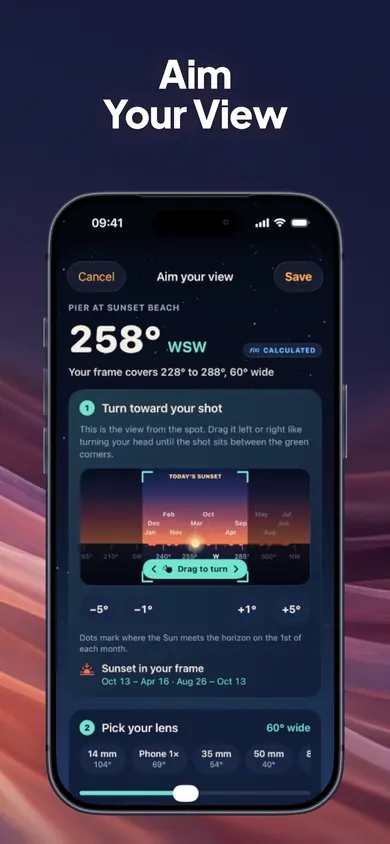
It sets due west only around the equinoxes, EarthSky notes. In the Northern Hemisphere it sets north of west in summer and south of west in winter, so a spot that frames June's sunset can miss December's.
Stay. Clouds overhead often colour after sunset, and civil twilight runs until the Sun is 6° below the horizon, per the National Weather Service. Corfidi notes afterglows from high-altitude particles can peak about 15 minutes after sunset.
Clean air, high cloud, a clear gap toward the Sun. Everything else is detail.
Try it on tonight's sky
Will the sunset be good tonight? A quick read
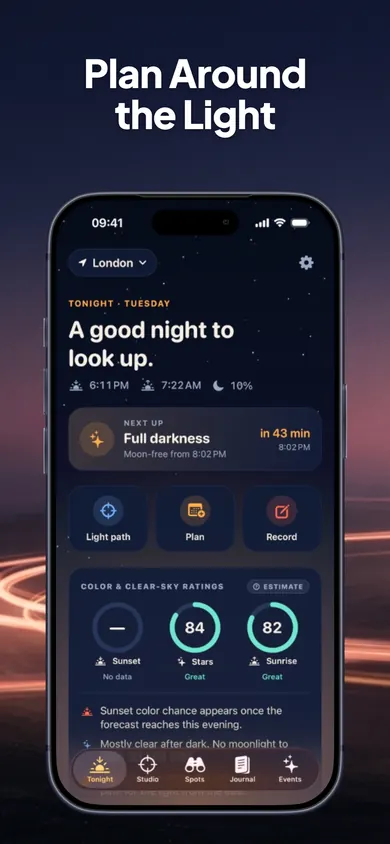
This is a rule of thumb, not a forecast. It cannot see the clouds 60 or 180 km toward the Sun, which is exactly where a hidden low bank ruins the light. That's the gap Asterfold's Tonight screen is built to fill.
Honest limits
What no sunset forecast can promise
We build Asterfold, so here is what it can't do. Its Sunset, Stars and Sunrise ratings are a rule-of-thumb estimate, not a probability or a guarantee. Sun positions assume a flat horizon; hills, buildings and trees are not modelled, so a ridge to your west can end your sunset early. Cloud data is hour-by-hour low, mid and high cloud from MET Norway, and forecasts can be wrong. The app labels calculated, forecast, estimated and observed data differently so you can tell which is which.
| In Asterfold | Type | How sure |
|---|---|---|
| Sunset time, bearing, golden hour | Calculated | Exact for a flat horizon |
| Low, mid, high cloud by hour | Forecast | As good as MET Norway's run |
| Sunset colour rating | Estimate | Rule of thumb |
| Your journal check-ins | Observed | What you actually saw |
A worked evening
One sunset, planned the slow way
Say you have a pier you like and an evening free. At lunch, Tonight shows patchy mid cloud and a fair Sunset rating, with the reasons in plain English. You open the Studio and drag the Sun along today's path: it sets a few degrees left of your pier's end. In Aim Your View you turn the horizon to your spot and pick a 50 mm frame. The Sun lands inside it.
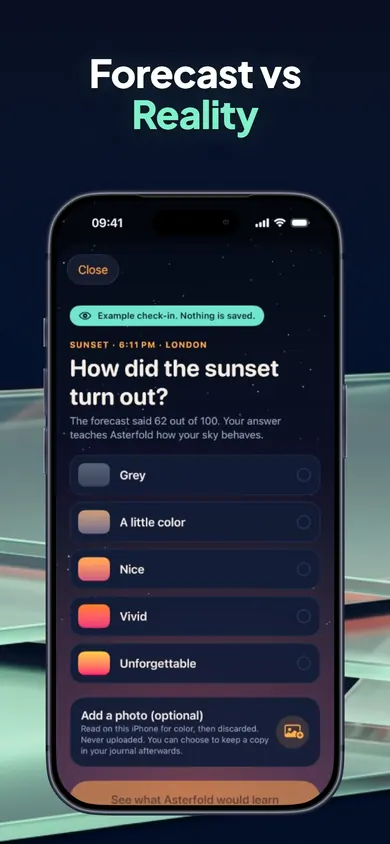
Late afternoon, the point forecasts 60 km and 180 km toward the setting Sun still show no low bank. You go. Afterwards you rate what you saw in two taps, and Asterfold compares it with the forecast it saved before the sunset, never a later one. After three check-ins, your colour ratings adjust to your own sky in small, capped steps.
Inside the app
The sunset planner, screen by screen
Fair warning
Who should pick something else
- You need a full weather app. Asterfold has no radar, rain alerts or wind maps. It is about light and cloud at your viewpoints.
- You shoot in hills or a city canyon. The flat-horizon assumption matters more for you. Check your local skyline by eye.
- You want ten days ahead for free. The free version covers tonight and the next 3 evenings. The 10-day outlook is part of Asterfold Plus, an optional subscription.
- You're on Android. Asterfold is iPhone only.
How it works
Sunset planning in three steps
- 1
Save the spot
Save the exact place you watch from. Free covers plans for 2 viewpoints, calculated on your iPhone so it works offline.
- 2
Check tonight
Read the Sunset rating, the cloud layers and the point forecasts toward the setting Sun.
- 3
Record the sky
Rate it in two taps afterwards. Your journal stays on your iPhone, with no account and no analytics.