Asterfold app iconGolden Hour Planner/ Asterfold

Watch the sunset every day challenge

Stop scrolling at dusk. Watch seven sunsets.

For anyone who keeps missing the light: seven evenings, one small mission each. Tap a night when it's done.

By the Asterfold team · Updated November 2026

Night 1: just go outside and look west. That's it.

Download on the App StoreDownload free on the App Store · Free on iPhone

Why watch the sunset every day?

Because it's a short, free, repeatable dose of awe, and awe seems to add up. In a 2020 study, older adults who took weekly 15-minute walks while looking for awe reported more positive emotion and less daily distress over eight weeks than walkers who didn't. A sunset is the easiest awe there is to schedule.

That study, led by Virginia Sturm at UCSF and published in the journal Emotion in September 2020, followed 52 healthy older adults. The awe group also took selfies on each walk, and over time they placed themselves smaller in the frame and smiled more, according to the UCSF release on EurekAlert. The control walkers walked more often but showed no such change. It's one small study, so we hold it lightly. But it fits what most people already suspect after a good evening sky.

Fifteen minutes, looking at something bigger than you, most nights of the week.

The 7-day sunset challenge plan

  1. Night 1

    Just look

    Go outside 10 minutes before sunset. Face the light. No phone in your hand.

  2. Night 2

    Find the exact spot

    Note where on your horizon the Sun goes down. It shifts a little every day.

  3. Night 3

    Stay for the afterglow

    Wait 15 minutes past sunset. Clouds overhead often colour after the Sun is gone, and civil twilight lasts until the Sun is 6° down, per the National Weather Service.

  4. Night 4

    Read the clouds first

    Before you go, guess: grey, a little colour, or vivid? Check yourself afterwards.

  5. Night 5

    Make yourself small

    Take one photo with lots of sky and little you, like the awe walkers did.

  6. Night 6

    Bring someone

    Invite a friend, partner or kid. Say nothing for the first five minutes.

  7. Night 7

    Write one line

    What did the week of skies have in common? Keep the line.

Where Asterfold helps

None of this needs an app. But if you'd like the plan to stick, these are the three screens we'd use.

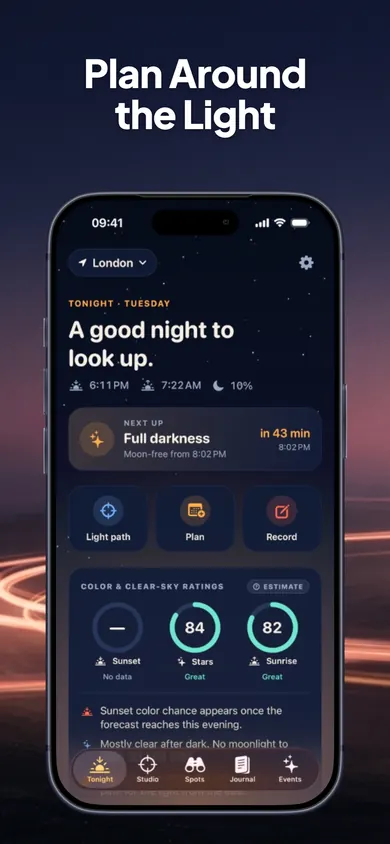
Asterfold Tonight screen with sunset time and ratings
Tonight: time and a plain-English read
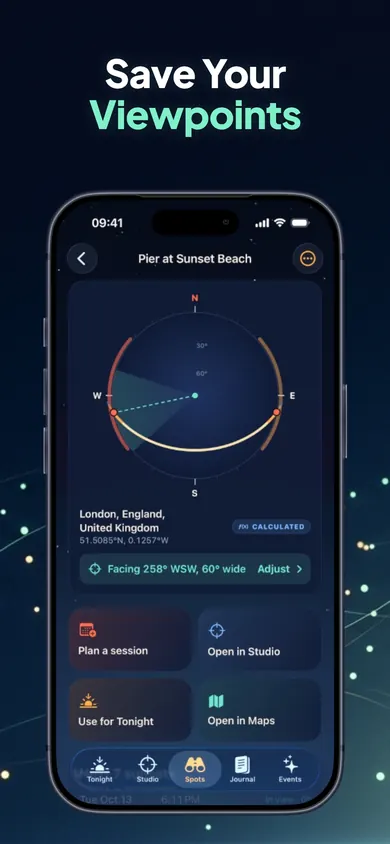
Asterfold saved viewpoint facing west-southwest
Save your watching spot
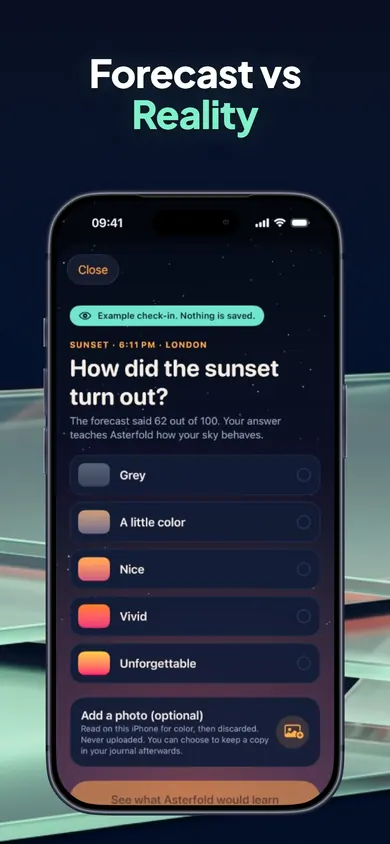
Asterfold check-in asking how the sunset turned out
Log the sky in two taps

What a week of sunsets looked like for us

The first night is the hardest, because it's an interruption. Dinner is half made, someone needs a bath. By night three it becomes the interruption you look forward to: you know when the Sun goes, because Tonight told you at lunch, and you know where, because you watched it go behind the same roofline two nights running.

Night four is where it gets interesting. You guess "vivid", it turns out grey, and Asterfold's journal compares your rating with the forecast it saved earlier that day, never a later one. After three check-ins your colour ratings start to adjust to your own sky, in small, capped steps. By night seven you're reading clouds on the way home from work.

The habit isn't the photo. It's turning around at the right time.

How to run the challenge with Asterfold

  1. Save one viewpoint. Your balcony, a park bench, the end of your street. Free covers plans for 2 viewpoints.
  2. Set a reminder. Plan a session for sunset or golden hour and add a reminder and a short checklist.
  3. Check in after. Rate what you saw in two taps, then add colours, clouds or a note if you like. Journal entries and photos stay on your iPhone.

Honest limits

Asterfold's sunset times assume a flat horizon; hills, buildings and trees are not modelled, so your real sunset may come a few minutes early. Its ratings are a rule-of-thumb estimate, not a guarantee, and cloud forecasts from MET Norway can be wrong. And the awe study above was small, in older adults, and didn't test sunsets or an app. A design decision we're glad of: the journal has no streaks, so a missed night costs nothing.

Sunset challenge questions

What if it's cloudy or I miss a night?

Count it anyway if you went out and looked. A grey sunset logged honestly is still a data point. If you miss a night, carry on the next evening; the plan has no streak to break.

How long does each evening take?

About 15 minutes outside, plus a minute to log what you saw. Arriving 10 to 15 minutes before sunset and staying a little after covers the best light.

Do I need a camera?

No. Your eyes are enough. Night 5 suggests a photo, but you can skip it.

Who should pick something else

  • You live far north in winter. Sunsets can fall mid-afternoon; a sunrise version of this plan may suit you better.
  • You want a general weather app. Asterfold has no radar or rain alerts.
  • You'd rather not use a phone at dusk at all. Print the seven nights above and use a paper notebook instead.
  • You're on Android. Asterfold is iPhone only.

See you out there, around 15 minutes before the light goes. — the Asterfold team

Night one is tonight.

Check when and where the Sun sets from your spot, then go and look.

Download on the App StoreDownload free on the App Store · Free on iPhone