The short answer
How long after sunset is it dark?
At mid-latitudes such as New York, the sky is fully dark about 90 to 125 minutes after sunset, depending on the season. You lose easy outdoor light sooner: civil dusk comes about 27 to 33 minutes after sunset there, and as little as 21 minutes near the equator.
Those figures come from the same Sun-angle definitions the National Weather Service uses: civil, nautical and astronomical twilight end when the centre of the Sun is 6, 12 and 18 degrees below the horizon. The calculator below runs that math for your latitude and date. It matches timeanddate's equinox figures of about 21 minutes of civil twilight in Quito, 28 in New York and 43 in Oslo.
"Dark" is three moments, not one: 6, 12 and 18 degrees.
Calculator
Dusk times after sunset for any city and date
| Stage ends | After sunset | Clock time |
|---|
Our own approximation of the Sun's position, usually within a few minutes. It assumes a flat horizon at sea level and ignores the Moon and city light.
Glossary, in order
Golden hour, blue hour and the three dusks on one timeline
Each term below is a slice of the same evening. They overlap, which is why people mean different things by "dusk".
Golden hour
Sun from about 6° above to 6° below the horizon
Warm, low, soft light. It has no official definition; timeanddate uses this range and gives about 50 minutes in Quito and over 90 in Oslo in March. It starts before sunset and runs into civil twilight.
Source: timeanddate, golden hour
Sunset
Top edge of the Sun drops below a flat horizon
Listed sunset times include the bending of light by the air, so the Sun's centre is a little below the horizon by then. Hills to the west make your real sunset earlier.
Blue hour
Sun roughly 4° to 8° below the horizon
The deep blue sky photographers wait for. It straddles civil dusk, lasts minutes rather than an hour, and runs longer farther from the equator.
Source: timeanddate, blue hour
Civil dusk
End of civil twilight
Until now you could usually see the horizon and objects around you without a lamp, and the brightest planets appear. The NWS says artificial light is often not needed before this point.
Source: National Weather Service
Nautical dusk
End of nautical twilight
Named for sailors, who could still see the horizon to take star readings. Outlines are visible, but detailed tasks outdoors need a light.
Astronomical dusk
End of all twilight
Most people would call the sky fully dark well before this. Astronomers wait for it to see faint galaxies and nebulae.
Night
Sun more than 18° below the horizon
No sunlight left in the sky. Above about 48.5° latitude this never arrives around the June solstice.
Most people's "it's dark now" lands between civil and nautical dusk.
Honest limits
Why the sky may look darker or lighter than the numbers
- Hills, trees and buildings. Twilight times assume a flat sea-level horizon. In a valley it feels darker sooner.
- Cloud. Thick cloud can make civil twilight feel like night. Clear air stretches it.
- The Moon and city light. They don't change twilight times, but they change how dark it looks.
- One design decision: the calculator only needs latitude, because twilight length depends on latitude and date, not longitude. Add your local sunset time to get clock times.
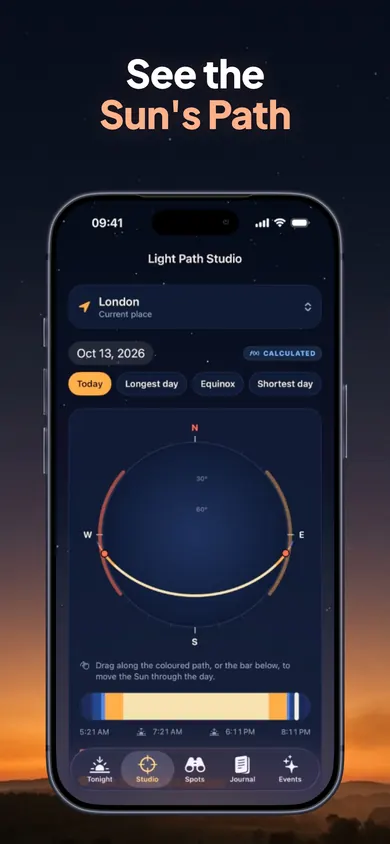
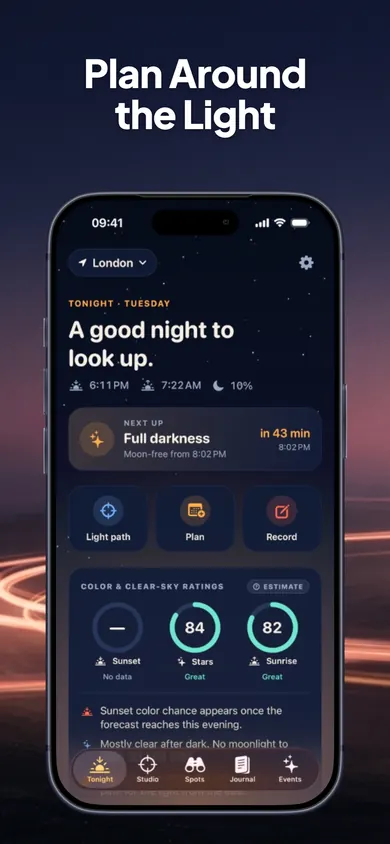
Asterfold draws the Sun's real path for any place and date, coloured by golden hour, blue hour and twilight, and lets you scrub through the evening for the Sun's altitude and bearing. It is calculated on your iPhone, so it works offline. It shares one limit with this page: Sun positions assume a flat horizon.
Fair warning
Who should pick something else
- You need legal lighting times. Rules for headlights, hunting or flying use their own definitions. Check your local authority.
- You want a dark-sky map. Asterfold rates sunsets, stars and sunrises, but it is not a light-pollution map.
- You're on Android. Asterfold is iPhone only.
FAQ
Dusk and darkness questions
Is dusk the same as sunset?
No. Sunset is the moment the top of the Sun drops below the horizon. Dusk is the end of a twilight stage. Said on its own, dusk usually means civil dusk, about 20 to 50 minutes after sunset for most people.
Why does it get dark faster in the tropics?
Near the equator the Sun drops almost straight down, so it passes through the 6, 12 and 18 degree marks quickly. Farther from the equator it sets at a slant and takes longer to sink the same distance.
Why does it never get fully dark in summer where I live?
Above about 48.5 degrees latitude, the Sun does not sink 18 degrees below the horizon around the June solstice, so astronomical twilight lasts all night. Closer to the poles, even nautical or civil twilight can last until dawn.
Does the Moon change how dark it gets?
Twilight times only track the Sun. A bright Moon can make the sky noticeably lighter after astronomical dusk, and city light pollution can stop it ever looking fully dark.
See tonight's dusk from your spot.
Golden hour, blue hour and twilight drawn on the sky for the place you actually watch from. Free to download, works offline.