Is sunrise or sunset better for photography?
Neither has better light by default: the sun sits at the same angles going down as coming up, so golden hour and blue hour look alike on paper. The real differences are around the light. Sunrise often brings calmer air, mist and empty viewpoints. Sunset is easier to plan for and to get to, and you can watch the sky build all afternoon.
The color itself depends on the air. NOAA forecaster Stephen Corfidi's essay The Colors of Sunset and Twilight says "clean air is, in fact, the main ingredient common to brightly colored sunrises and sunsets," and that haze in the lower atmosphere subdues sky colors rather than enhancing them. So the cleaner sky wins, whichever end of the day it falls on.
Pick sunrise for stillness and solitude; pick sunset for convenience and a sky you can watch develop.
Sunrise vs sunset, for your city and date
Both windows side by side, worked out on this page for a flat horizon. Golden hour here runs from the sun 6° above the horizon to 4° below, and blue hour from 4° to 8° below, the ranges timeanddate uses in its blue hour guide.
Sunrise
- Blue hour starts
- –
- Sunrise
- –
- Golden hour
- –
- Look toward
- –
- Be set up by
- –
Sunset
- Golden hour starts
- –
- Sunset
- –
- Golden hour
- –
- Look toward
- –
- Blue hour ends
- –
Calculated with a standard solar position formula, accurate to about a minute at the city center. Hills and buildings shift the times.
Sunrise vs sunset photography, point by point
| Sunrise | Sunset | |
|---|---|---|
| Light angle | Same golden and blue hour angles, in reverse order: blue first, then gold. | Gold first, then blue. Same angles. |
| Sky color | Set by how clean the air is and where the clouds are, per NOAA. | Same rule. Neither end is redder by default. |
| Mist and fog | More likely. The National Weather Service says radiation fog needs clear skies and calm wind, and often lasts until sunrise.Sunrise | Less likely: radiation fog builds overnight as the ground cools. |
| Planning | You decide the night before, in the dark. | You can watch the clouds all afternoon and decide late.Sunset |
| Getting there | An early alarm and an approach in the dark. | Daylight approach; a walk back in the dark.Sunset |
| Crowds | Usually fewer people at popular viewpoints.Sunrise | Busier at well-known spots. |
| Direction | East of the horizon, mirrored: north of east in summer, south in winter. | West: north of west in summer, south in winter. |
The fog row comes from the National Weather Service's fog forecasting notes, which list clear skies and calm to very light wind as the setup for radiation fog, and say widespread fog usually stays until sunrise. That's the low mist in a valley or over a lake that only morning shooters tend to see.
The light is a tie; the logistics decide it.
How to try both in one weekend
- Friday sunset: scoutShoot the evening from a spot that faces both ways, like a hill or a long beach. Note which way the sun set.
- Saturday sunrise: same spot, other sideBe set up by the start of blue hour from the calculator. The first 20 minutes are the ones people sleep through.
- Sunday: compare honestlyLook at both sets side by side. Which did you enjoy getting up, or staying out, for? That's your answer.
Where Asterfold helps either way
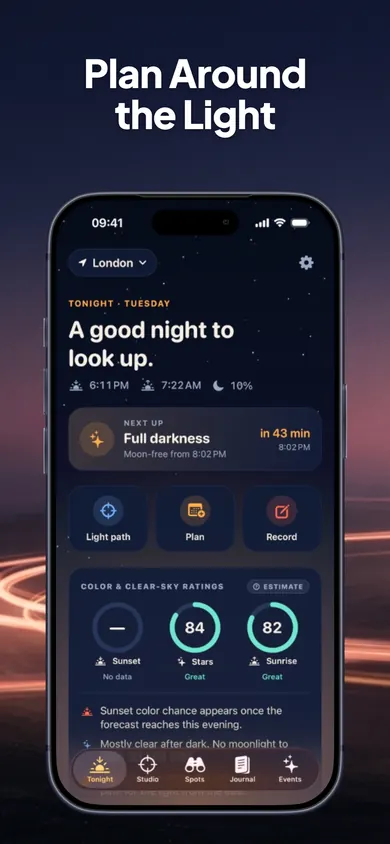
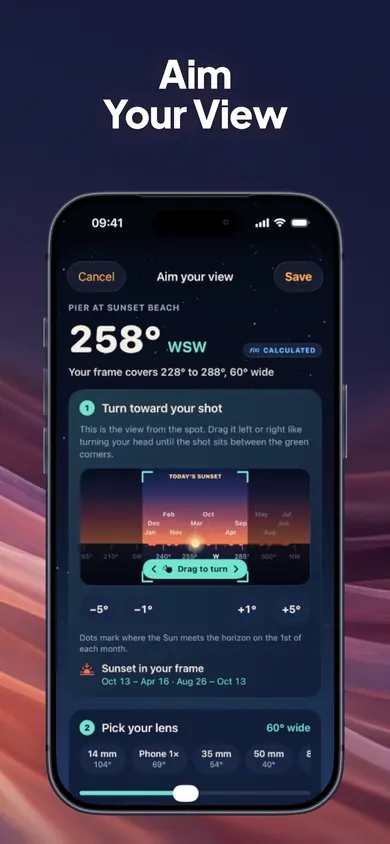
Asterfold is our sunset planner, and it covers mornings too. Its Tonight screen gives Sunset, Stars and Sunrise ratings with plain-English reasons, built from MET Norway's hour-by-hour low, mid and high cloud. The Light Path Studio draws the sun's real path for any place and date, and Aim Your View shows the dates this year when the sun sets or rises inside your frame.
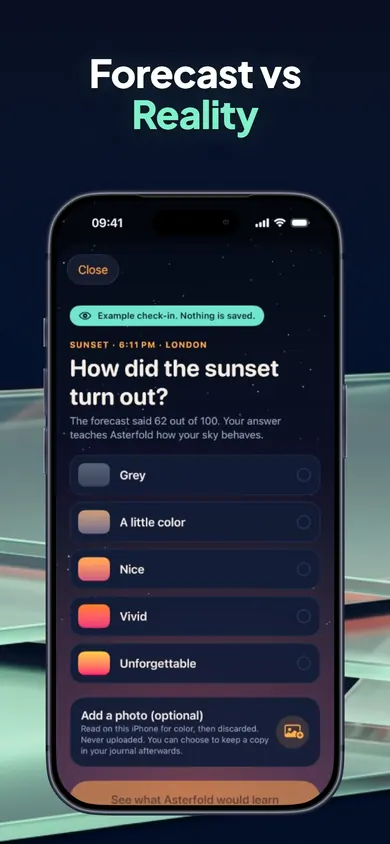
After each shoot, the field journal lets you rate what you saw in two taps and compares it with the forecast saved beforehand. After three check-ins, your color ratings adjust to your own sky.
Sunrise and sunset questions
Is golden hour the same length at sunrise and sunset?
Nearly. On a given day the sun climbs through the same angles in the morning that it drops through in the evening, so the two golden hours are within a minute or two of each other. The calculator above shows both.
Are sunsets more colorful than sunrises?
Not by rule. NOAA's Stephen Corfidi says clean air is the main ingredient common to brightly colored sunrises and sunsets, and that low-level haze subdues the colors. Whichever sky is cleaner, with clouds in the right place, tends to win.
Why do my sunrise photos look cooler in color?
Partly order. At sunrise blue hour comes first and the gold arrives as the sun clears the horizon; at sunset the gold comes first. If you stop shooting at sunrise itself, you've mostly shot the blue part.
Does Asterfold rate sunrises?
Yes. The Tonight screen includes a Sunrise rating alongside Sunset and Stars. The ratings are a rule-of-thumb estimate, not a probability or a guarantee.
Honest limits
We built this as a tie on purpose: the geometry really is symmetric, and a page that crowns one side would be selling you something. The calculator and Asterfold both assume a flat horizon; hills, buildings and trees are not modelled, so a ridge to the east can delay your sunrise by many minutes. Who should pick something else: if you only want tomorrow's sunrise and sunset times, your phone's weather app has them already.
Choose your end of the day. Then aim it.
Light Path Studio, aiming and plans for 2 viewpoints, the journal and tonight's ratings are free in Asterfold.