What is blue hour, and why do people miss it?
Blue hour is the deep-blue stretch of twilight when the sun is about 4° to 8° below the horizon, after sunset or before sunrise. At mid-latitudes it lasts roughly 20 to 30 minutes and starts about 20 minutes after sunset. People miss it mostly by leaving at sunset, or by arriving at sunrise for the morning one.
The term isn't official. The angles come from timeanddate's blue hour guide, which says the blue is most likely between 4° and 8° below the horizon and that it lasts about 20 minutes around 40° north in March, about 16 minutes in Quito and about 30 near Oslo. Those angles sit inside the civil and nautical twilight bands that the U.S. Naval Observatory defines at 6° and 12°.
Blue hour starts when most people have already left, and ends before they'd think to come back.
One evening on the bridge
An illustration, not a real shoot.
Sunset at 4:38. The crowd on the footbridge takes its photos of the orange sky and drifts off by 4:45. You stay, set the tripod and switch white balance to daylight. At 4:57 the sky goes from grey to a clean, deep blue, and the office windows across the river match it for brightness. By 5:15 the sky is too dark and the lights are blowing out. You've got about fifteen frames from a twenty-minute window, and two of them are keepers.
How long after sunset is blue hour?
Worked out on this page for a flat horizon, using the 4° to 8° window. "Starts" is minutes after sunset; "lasts" is the length of the blue. Notice it starts later, and lasts longer, the farther you are from the equator.
Each cell: starts +minutes after sunset, then how long it lasts. Morning blue hour is the mirror image, before sunrise.
Blue hour questions
Is blue hour before or after golden hour?
In the evening, blue hour comes after golden hour and sunset. In the morning it's the other way round: blue hour first, then sunrise and golden hour.
How long does blue hour last?
Usually 20 to 30 minutes at mid-latitudes. timeanddate gives about 16 minutes in Quito near the equator and roughly 30 minutes near Oslo at the equinoxes.
What white balance should I use for blue hour?
Pick a fixed setting such as daylight instead of auto, so the camera doesn't warm the blue away, and shoot RAW if you can so you can adjust it later.
Can I shoot blue hour on a phone?
Yes. Brace the phone or use a small tripod, try HDR or night mode, and expose for the sky. timeanddate suggests your phone's HDR mode to balance sky and subject.
Is Asterfold free?
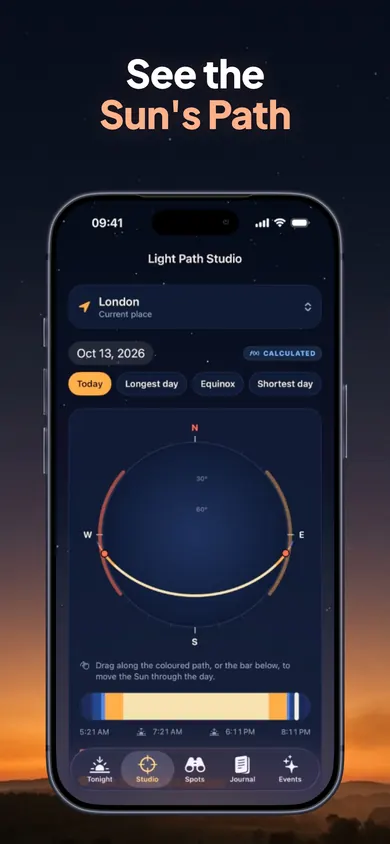
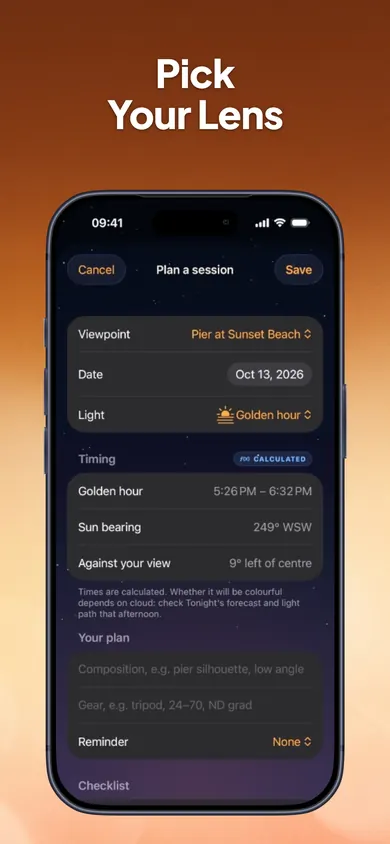
Yes. Free includes the Light Path Studio, aiming and plans for 2 viewpoints, the field journal, tonight's ratings and the next 3 evenings. Asterfold Plus is optional and adds unlimited viewpoints, sky alerts and the full 10-day outlook.
Who this is not for, and honest limits
If you shoot the Milky Way, blue hour is your warm-up, not your subject; you want astronomical darkness, which comes later. If you only want the sunset itself, any weather app's sunset time will do.
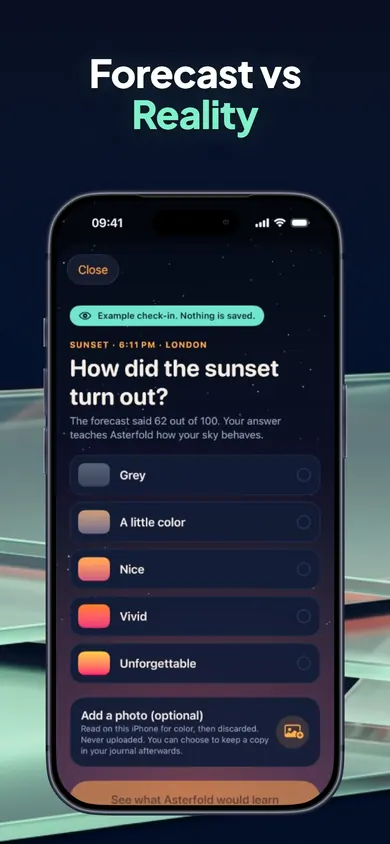
All times here assume a flat horizon, and so does Asterfold: its listing says hills, buildings and trees are not modelled. Neither can promise a clean blue; heavy cloud turns it grey. Asterfold's ratings are labelled as a rule-of-thumb estimate, not a probability.