How many minutes of daylight do we lose each day?
It depends on where you are and the date. In early November, New York loses about 2 minutes 20 seconds of daylight a day, London about 3½ minutes, and Miami about 1¼ minutes. The loss is fastest around the September equinox, slows through November and early December, and drops to almost nothing at the December solstice.
Those figures are worked out on this page for November 4, 2026, from sunrise to sunset over a flat horizon. The pattern matches the University of Wisconsin's Weather Guys explainer, which says day length "is changing fastest at the equinoxes" and that there is "essentially no change in length of day from one day to the next at the time of the solstices."
The days shrink fastest in September, not December, and farther from the equator they shrink faster.
Daily change in daylight, minute by minute, through 2026. Above the line: days getting longer.
Daylight lost per day, by city
Minutes of daylight gained or lost from one day to the next, worked out on this page for 2026. Negative numbers are days getting shorter.
| City | Sep 22 | Nov 4 | Dec 21 | Jan 15 |
|---|---|---|---|---|
| Miami | −1.5 | −1.3 | 0.0 | +0.8 |
| New York | −2.7 | −2.3 | −0.1 | +1.5 |
| Seattle | −3.4 | −3.0 | −0.1 | +2.0 |
| London | −3.9 | −3.5 | −0.1 | +2.4 |
| Edinburgh | −4.6 | −4.2 | −0.1 | +2.9 |
| Singapore | −0.1 | −0.1 | 0.0 | 0.0 |
Minutes per day, sunrise to sunset, flat horizon. Rounded to a tenth of a minute. You can cross-check any date with NOAA's Solar Calculator.
Why the days shorten faster in fall
Day length follows a smooth wave through the year. At the top and bottom of the wave, the solstices, it's flat, so one day is almost the same length as the next. Halfway between, at the equinoxes, it's steepest, so the change per day is biggest. Latitude sets the height of the wave: Edinburgh's day runs from about 7 hours in December to over 17½ in June, so its daily change is big. Singapore's barely moves.
One more twist: sunset and sunrise don't move evenly. Around the December solstice, the earliest sunset arrives a couple of weeks before the solstice and the latest sunrise a couple of weeks after. Our page on the earliest sunset of the year covers that.
After December 21 the days lengthen again, slowly at first: about a minute and a half a day in New York by mid-January.
How to keep your evenings as the light shrinks
- Know tonight's sunset, not last week'sIn November the sunset moves a minute or more earlier every day or two. Check the calculator above for the date you're planning.
- Move the walk, not the habitIf you catch the sunset after work, shift a lunch break or a weekend afternoon walk so you're still out in the light.
- Stay for the twilightThe sky stays light for a while after sunset. Our dusk calculator shows how long for your city.
The short days, in Asterfold
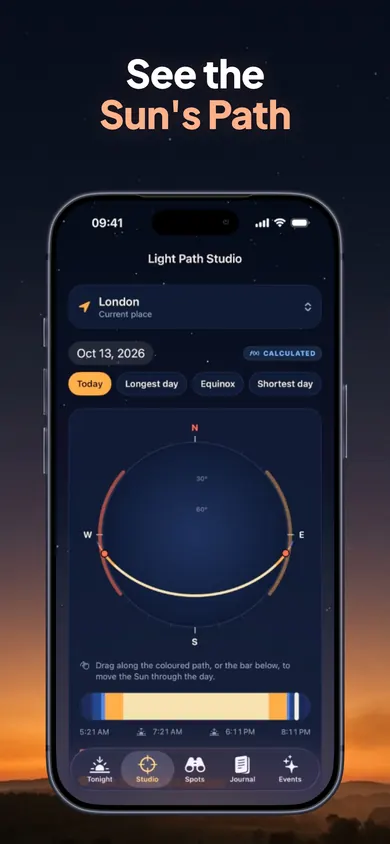
The year's key dates, one tap away. The Light Path Studio draws the sun's real path for any place and date, with shortcuts to the year's key dates such as the shortest day.
Scrub through the day for the sun's altitude, bearing and shadow length. It's calculated on your iPhone, so it works offline.
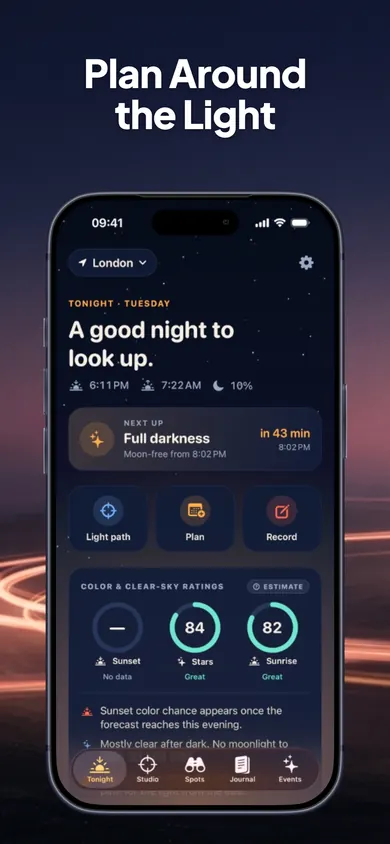
Tonight, with reasons. Sunset, Stars and Sunrise ratings in plain English, with golden hour, blue hour, Moon and planets.
Hour-by-hour low, mid and high cloud comes from MET Norway, with point forecasts 60 km and 180 km toward the setting sun.
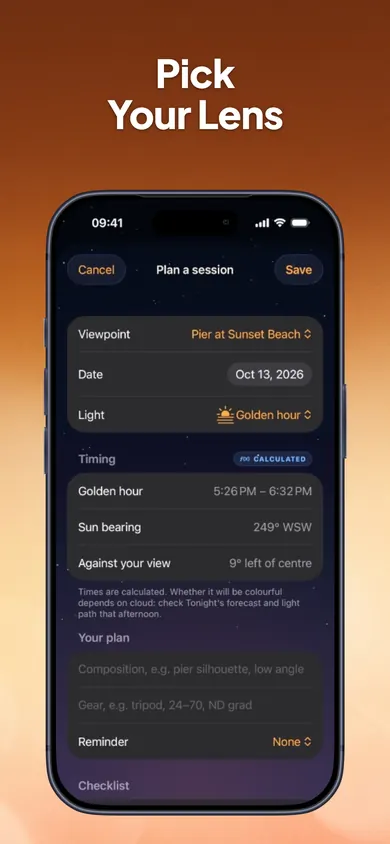
A reminder before the light goes. Plan a session for golden hour, sunset or blue hour, then add a reminder and a short checklist.
On a winter weekday, that reminder is what gets you out the door before 4:30.
Daylight questions
When do we lose the most daylight each day?
Around the September equinox. Day length changes fastest at the equinoxes and barely changes at the solstices, so the biggest daily losses come in late September.
When do the days start getting longer?
After the December solstice, on December 21 in 2026, in the Northern Hemisphere. The gain is tiny at first and speeds up toward the March equinox.
Why does my city lose more daylight than a city farther south?
Day length swings more over the year the farther you are from the equator, so the daily change is bigger too. Near the equator day length hardly changes at all.
Is this calculator accurate?
It's accurate to about a minute for a flat horizon at the city center. Hills, buildings and your exact location shift sunrise and sunset a little.
Honest limits
We count daylight from sunrise to sunset, the usual definition, even though the sky stays light for a while after. Every number here assumes a flat horizon; Asterfold makes the same assumption, and its listing says hills, buildings and trees are not modelled. Who should pick something else: if you just want to know how dark winter will feel where you live, your phone's weather app shows sunrise and sunset. Asterfold is for people who plan around the light: photographers, walkers, sunset watchers.
Less light. Better use of it.
Light Path Studio, aiming and plans for 2 viewpoints, the field journal and tonight's ratings are free in Asterfold.